
Bitcoin to Monero: a complete guide to private crypto swaps
Monero uses ring signatures, stealth addresses, and confidential transactions to break that link. Swapping Bitcoin to Monero is a routine operation that takes minutes. When you convert BTC to Monero, you are moving from an asset that publishes your activity to one that does not. Bitcoin and Monero solve different problems. Bitcoin is a transparent…

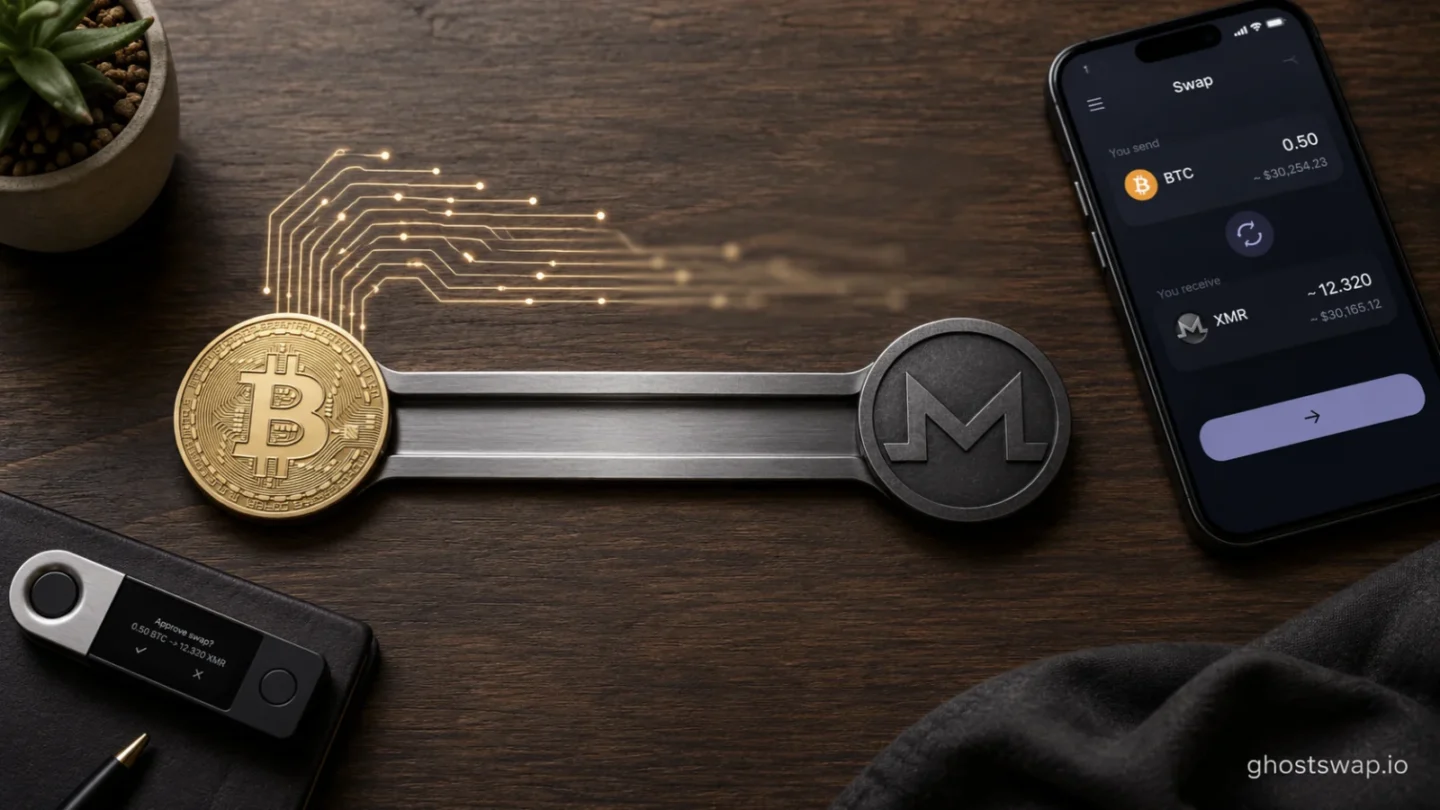
- Monero severs transaction links using ring signatures, stealth addresses, and confidential transactions.
- Converting Bitcoin to Monero is a straightforward process that is completed in minutes.
- Trading BTC for Monero shifts your funds from a fully public ledger to a highly private network.
Bitcoin and Monero serve entirely different functions. While Bitcoin operates on an open, transparent ledger where every transaction is permanently visible, Monero is designed to hide the sender, recipient, and transaction amount by default.
Exchanging value between these two cryptocurrencies is a frequent practice. This guide explains how these swaps work, the expenses involved, and the key risks to watch out for.
Understanding what changes when you swap
When you hold Bitcoin, anyone with knowledge of your address can view its entire history, including transaction origins, destinations, and total balances.
This transparency is not a system failure; it is the mechanism Bitcoin uses to achieve consensus without relying on a central authority. However, it means your financial transactions are public by default.
Monero disrupts this traceability by employing stealth addresses, ring signatures, and confidential transactions.
This ensures that wallet balances remain hidden and outside observers cannot determine which specific user initiated a transaction.
Monero’s official documentation describes this protection as “plausible deniability” rather than an airtight guarantee—a realistic and honest distinction.
Ultimately, swapping Bitcoin for Monero means migrating your capital from a network that broadcasts your transactions to one that conceals them.
Custodial versus non-custodial routes
The method you choose dictates your entire transaction experience, making it crucial to understand the differences between these two paths.
A custodial exchange takes direct custody of your Bitcoin, updates its internal ledger to reflect your trade, executes the transaction on its own platform, and then allows you to withdraw the funds. During this process, the platform holds your money.
This approach requires creating an account, passing identity verification checks, and trusting that the exchange remains solvent and functional. Additionally, many custodial platforms have delisted Monero entirely.
Conversely, a non-custodial swap never holds your funds on deposit. You simply send Bitcoin to a temporary deposit address, the service processes the trade through its liquidity channels, and the Monero is sent straight to your designated wallet.
This method eliminates the need for accounts, stored balances, or manual withdrawal steps. Platforms like GhostSwap utilize this non-custodial framework, supporting roughly 1,600 different assets.
The mechanics, in order
Executing a non-custodial swap requires five basic inputs and generally takes about eight minutes once your initial deposit is confirmed on the blockchain.
- Select your trading pair: deposit Bitcoin to receive Monero.
- Choose between a floating or fixed rate. Floating rates settle at the prevailing market price when the funds arrive, while fixed rates lock in the price for a small premium—a feature highly recommended for larger transactions.
- Provide the destination Monero address where your funds should be sent.
- Enter a Bitcoin refund address. If the transaction fails to complete, your Bitcoin will be automatically returned here.
- Send the Bitcoin to the provided deposit address and wait for the transaction to confirm.
The exact same steps apply in reverse if you want to trade Monero back into Bitcoin—a common route for privacy-focused users who periodically move funds back into more liquid markets.
Costs, and where they hide
Swapping involves two distinct types of expenses, which are frequently confused. The service fee is disclosed upfront and usually represents a small percentage of the total transaction.
Network fees, on the other hand, are paid directly to the Bitcoin and Monero blockchains and fluctuate based on network traffic.
During periods of high congestion, network fees on smaller swaps can easily outpace the service fee itself. Because of this, you should always review the total estimated cost rather than relying solely on the advertised percentage fee.
Fixed-rate swaps offer slightly less favorable exchange rates than floating options in exchange for price certainty.
While this premium is rarely worth paying on small transactions, it is highly valuable for large trades to protect against market fluctuations during the confirmation window.
Practical cautions
Ensuring address accuracy is paramount. Monero addresses are exceptionally long, and blockchain transfers cannot be reversed. Always copy and paste the address, then carefully double-check the first and last few characters.
Never skip setting a refund address. This free step is the difference between receiving an automatic refund and having to resolve the issue with customer support.
Be aware of compliance policies. Non-custodial platforms route transactions through regulated liquidity providers that automatically scan incoming deposits. Consequently, the vast majority of swaps are completed without any identity checks.
However, if a deposit is flagged as linked to illicit activity, it may be frozen for a compliance review. This decision is controlled by the liquidity partner’s compliance protocols rather than the swap platform itself. While rare, a complete guide must highlight this possibility.
Summary
Converting Bitcoin to Monero is a simple, routine transaction that takes only a few minutes and can be completed without an account via non-custodial platforms.
The core rules for a successful swap are straightforward: double-check your destination address, always provide a refund address, look at the total final cost instead of just the percentage fee, and opt for fixed rates on larger transfers.